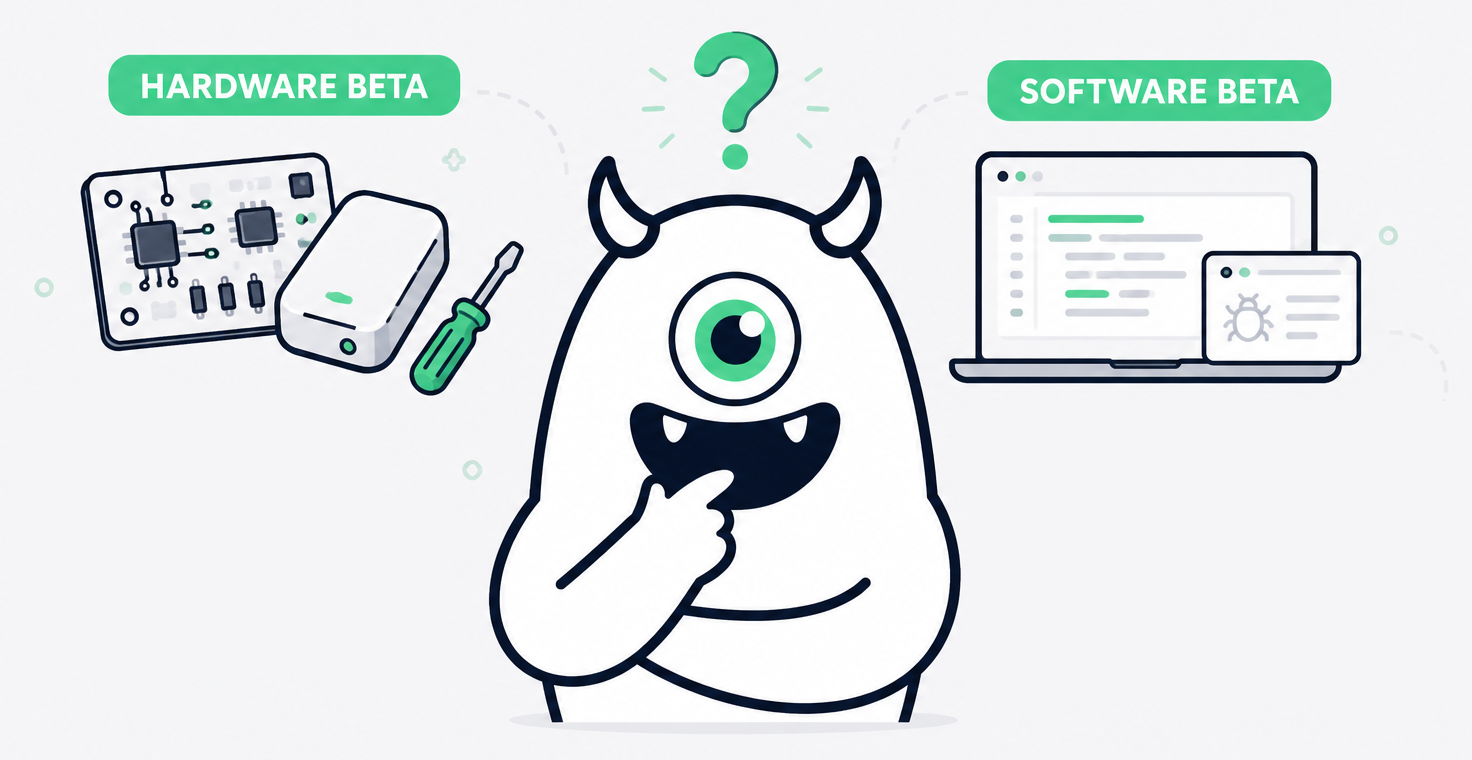
The average hardware beta program gets 10% tester engagement.
If you recruit 200 testers, that means maybe 20 of them end up participating in any meaningful way. The other 180 sign the NDA, accept the device, maybe even unbox it, and then go quiet.
For a software team shipping a mobile app, 10% can sometimes be survivable. You still have telemetry, crash logs, funnels, and plenty of passive signal.
For a hardware team shipping a connected device, it is a different story. When engagement drops that low, so does your visibility into what is actually happening in the field. That is not just inconvenient. It is a launch risk.
This is the pattern we see again and again: hardware teams borrow a software beta model, run into predictable drop-off, and then blame motivation. Most of the time, the real problem is structure.
The Fundamental Mistake: Treating Hardware Beta Like Software Beta
Software teams have been running beta programs for decades, and most of the industry's tooling and playbooks were built around their needs.
The model is familiar: recruit users, ship a build through TestFlight or a download link, collect crash reports and feedback, fix the biggest issues, ship.
Hardware teams inherited that model and tried to apply it to a very different kind of test.
That is where things start to break.
In software testing, the environment is mostly controlled.
A web app running in Chrome on a MacBook is still that same web app running in Chrome on a MacBook whether the user is in Austin or Amsterdam. There are variables, of course, but they are relatively bounded.
In hardware testing, the environment is the point.
A smart home hub behaves differently on a mesh network than it does on a single router. It behaves differently when installed next to a microwave throwing off 2.4 GHz interference. It behaves differently after 45 days of continuous use than it does after 45 minutes on a bench in the lab.
Those are not annoying edge cases. They are the whole reason you run a hardware beta in the first place.
You are not just testing whether the software works. You are testing whether the product works in the real world, which is messy, inconsistent, and impossible to replicate perfectly in-house.
The feedback itself is different too.
Software beta feedback is often transactional. "This button doesn't work." "The app crashes when I do X." Those are discrete, reproducible issues.
Hardware beta feedback is usually more contextual. "The device reconnects fine in my home office but drops in the kitchen." "Setup got confusing at step 4 because the diagram does not match the cable colors." "Everything works until day three, and then it starts acting strange."
That kind of feedback does not show up consistently unless the program is designed to draw it out. You need structured tasks, specific scenarios, and testers who stay engaged for weeks, not just a generic feedback button for when something goes wrong.
Then there is the cost of being wrong.
A software bug that slips through usually means a patch release and a few unhappy reviews.
A hardware bug that slips through can mean returns, recalls, compliance problems, and trust that takes years to rebuild.
The stakes are simply different. Yet many hardware teams are still expected to run their beta programs with tools and processes built for a much lower-risk environment.
Why do beta testers ghost?
Ghosting is so common in beta programs that a lot of teams treat it as normal. It should not be.
I hear the same explanation all the time: testers just were not motivated enough. So the solution becomes better incentives, gift cards, early access, exclusive perks.
Incentives can help at the margin. They do not fix a confusing program.
Across the programs we have seen, the pattern is pretty consistent: testers ghost when participation feels unclear, not just time-consuming.
Three things tend to kill engagement faster than anything else:
1. Vague tasks
"Test the device and tell us what you think" is not really a task. It is a request for an opinion.
Most testers do not know what "good" looks like, what they should pay attention to, or what kind of feedback will actually be useful. When the ask is vague, many people do nothing because they do not know where to begin.
Now compare that with this:
"Connect the device to a 2.4 GHz network and test this specific scenario. Note whether the connection drops during the 5-minute idle period. Report the exact sequence of steps you followed."
That is a task. It gives the tester a starting point, a success condition, and a useful reporting frame.
2. No feedback loop
If a tester submits a detailed report and hears nothing back, no acknowledgment, no follow-up, no signal that someone actually read it, they usually stop submitting.
That is not laziness. It is rational behavior.
People are much more willing to contribute when they can tell their contribution matters. One of the fastest ways to lose engagement is to make feedback feel like it disappeared into a black hole.
3. Front-loaded effort
Many beta programs dump every task into week one. Testers get overwhelmed, skip a few things, fall behind, and then feel like they have already failed the program. At that point, disengaging becomes the easiest option.
The programs that hold attention over time usually do the opposite. They pace the work, introduce complexity gradually, and adapt based on tester progress.
What Higher Engagement Actually Looks Like
The best programs we see do not rely on heroic manual follow-up or unusually motivated testers. They are simply designed better.
And when that design improves, the gap is not small. Well-structured programs can perform dramatically better than the 10% benchmark that so many teams have come to accept as normal.
Here is what those stronger programs tend to have in common:
Specific, hardware-native task design
The tasks are written for physical product testing, not for generic app feedback. They use step-by-step micro-instructions, account for real-world variables, and tell testers exactly what to do and what to report.
Automated, contextual engagement
Not generic reminder emails. Not "just checking in" blasts.
The useful version is contextual follow-up: acknowledging a report, asking for clarification on a specific issue, or checking whether a known fix changed the result for that tester.
There is a huge difference between "don't forget to participate" and "you reported a connectivity issue on Tuesday, did build 2.3 improve it?"
Persistent tester relationships
Hardware beta programs often run for four to eight weeks, not one afternoon. The teams that keep testers engaged treat them more like collaborators than survey respondents.
That means regular updates, clear expectations, visible progress, and genuine two-way communication throughout the program.
Synthesis that closes the loop
Engagement goes up when testers can see that their input led somewhere. That only happens when the team can connect tester feedback to product decisions and then communicate that back out clearly.
Why don't generic beta tools work for hardware?
Most beta testing tools were built for software companies shipping mobile apps or SaaS products. They are optimized for build distribution, crash reporting, and lightweight feedback forms.
For hardware teams, that creates a mismatch right away:
- Task frameworks that assume a user taps through a screen, not someone who needs to physically install a device at home or on-site
- Engagement systems designed for short tests, not multi-week field programs
- Reporting built for software defects, not contextual feedback shaped by environment and setup conditions
- No practical way to capture tester environments, device configurations, and real-world constraints in one place
So hardware teams usually end up doing one of two things: they use software-oriented tools and live with the mismatch, or they run the whole program out of spreadsheets, inboxes, and manual follow-up.
That is still how a surprising amount of the industry operates.
This is not really a criticism of those tools. Most of them are doing exactly what they were designed to do. Hardware beta is just a different problem.
The Questions Worth Asking About Your Beta Program
If you are running hardware beta programs, these are usually the questions that surface the real weak spots:
- Are your tasks specific enough that a tester could complete them without already knowing your product inside out?
- What happens after a tester submits feedback? Do they get acknowledgment, context, or follow-up?
- How are you pacing task distribution? Are you front-loading the work, or building momentum over time?
- What does week-three engagement look like compared with week one? Healthy programs do not collapse after the initial excitement wears off.
- Can you answer "are we ready to ship?" from the data you already have, or does it still take days of manual synthesis to get there?
The bottom line on hardware beta
Hardware beta testing will never be effortless. Real homes are messy. Testers are busy. The failures you need to catch are often slow, contextual, and hard to reproduce.
But low engagement is not just the unavoidable cost of doing hardware beta. In many cases, it is a design problem.
The teams that ship with confidence are not necessarily running bigger programs. They are running better-structured ones.
Engagement follows design. When the program is clear, paced well, and visibly responsive, testers stay in it.
That is the real opportunity: not chasing a vanity participation number, but building a beta program that matches how hardware testing actually works.
If you are weighing up how to run the next one, we wrote up what a connected-device program needs and an honest comparison of the alternatives, including where they beat us.
Ibrahim Menem is Co-Founder and CTO of Stomio, the AI-native beta program management platform built for B2B hardware teams.